

Core Elements of the Safety and Health Management Systems
These practices provide responsible employers, workers, and worker representatives with a sound, flexible framework for addressing safety and health issues in diverse workplaces in Hawaiʻi. They may be used in any workplace, but will be particularly helpful in small- and medium-sized workplaces. They can be applied equally well in traditional, fixed manufacturing workplaces and in the service sector, healthcare, retail , and even mobile or office-based work environments. They also include information specifically aimed at temporary temporary worker and multi-employer work situations.

Management provides the leadership, vision, and resources needed to implement an effective safety and health program. Management leadership means that business owners, managers, and supervisors:
- Make worker safety and health a core organizational value.
- Are fully committed to eliminating hazards, protecting workers, and continuously improving workplace safety and health.
- Provide sufficient resources to implement and maintain the safety and health program.
- Visibly demonstrate and communicate their safety and health commitment to workers and others.
- Set an example through their own actions.
Action item 1: Communicate your commitment to a safety and health program
A clear, written policy helps you communicate that safety and health is a primary organizational value –as important as productivity, profitability, product or service quality, and customer satisfaction.
How to accomplish it
Establish a written policy signed by top management describing the organization’s commitment to safety and health and pledging to establish and maintain a safety and health program for all workers.
- Communicate the policy to all workers and, at appropriate times and places, to relevant parties, including:
- Reinforce management commitment by considering safety and health in all business decisions, including contractor and vendor selection, purchasing, and facility design and modification.
- Be visible in operations and set an example by following the same safety procedures you expect workers to follow. Begin work meetings with a discussion or review of safety and health indicators and any outstanding safety items on a “to do” list.
Action item 2: Define program goals
By establishing specific goals and objectives, management sets expectations for managers, supervisors, and workers and for the program overall. The goals and objectives should focus on specific actions that will improve workplace safety and health.
How to accomplish it
- Establish realistic, measurable goals for improving safety and health. Goals emphasizing injury and illness prevention should be included rather than focusing on injury and illness rates.
- Develop plans to achieve the goals by assigning tasks and responsibilities to particular people, setting timeframes, and determining resource needs.
Action item 3: Allocate resources
Management provides the resources needed to implement the safety and health program, pursue program goals, and address program shortcomings when they are identified.
How to accomplish it
- Estimate the resources needed to establish and implement the program.
- Allow time in workers’ schedules for them to fully participate in the program.
- Integrate safety and health into planning and budgeting processes and align budgets with program needs.
- Provide and direct resources to operate and maintain the program, meet safety and health commitments, and pursue program goals.
Note: Resource needs will vary depending on your organization’s size, complexity, hazard types, and program maturity and development. Resource needs may include: capital equipment and supplies; staff time; training; access to information and tools (e.g., vendor information, Safety Data Sheets, injury/illness data, checklists, online databases); and access to safety and health experts, including HIOSH’s free and confidential Consultation Program.
Action item 4: Expect performance
Management leads the program effort by establishing roles and responsibilities and providing an open, positive environment that encourages communication about safety and health.
How to accomplish it
- Identify a front line person or persons to lead the safety program effort, make plans, coordinate activities, and track progress. Define and regularly communicate responsibilities and authorities for implementing and maintaining the program and hold people accountable for performance.
- Provide positive recognition for meeting or exceeding safety and health goals aimed at preventing injury and illness (e.g., reporting close calls/near misses, attending training, conducting inspections).
- Establish ways for management and all workers to communicate freely and often about safety and health issues without fear of retaliation.
Note: Maintaining a positive and encouraging tone is important. Successful programs reward, rather than discipline, workers who identify problems or concerns, much like successful quality programs. Disciplinary measures should be reserved for situations in which an individual manager or worker is uncooperative or becomes an impediment to progress.
#mgmt-leadership
To be effective, any safety and health program needs the meaningful participation of workers and their representatives. Workers have much to gain from a successful program and the most to lose if the program fails. They also often know the most about potential hazards associated with their jobs. Successful programs tap into this knowledge base.
Worker participation means that workers are involved in establishing, operating, evaluating, and improving the safety and health program. All workers at a worksite should participate, including those employed by contractors, subcontractors, and temporary staffing agencies (see “Communication and Coordination for Host Employers, Contractors, and Staffing Agencies“).
In an effective safety and health program, all workers:
- Are encouraged to participate in the program and feel comfortable providing input and reporting safety or health concerns.
- Have access to information they need to participate effectively in the program.
- Have opportunities to participate in all phases of program design and implementation.
- Do not experience retaliation when they raise safety and health concerns; report injuries, illnesses, and hazards; participate in the program; or exercise safety and health rights.
Note: Worker participation is vital to the success of safety and health programs. Where workers are represented by a union, it is important that worker representatives also participate in the program, consistent with the rights provided to worker representatives under the Occupational Safety and Health Act of 1970 and the National Labor Relations Act.
Action item 1: Encourage workers to participate in the program
By encouraging workers to participate in the program, management signals that it values their input into safety and health decisions.
How to accomplish it
- Give workers the necessary time and resources to participate in the program.
- Acknowledge and provide positive reinforcement to those who participate in the program.
- Maintain an open door policy that invites workers to talk to managers about safety and health and to make suggestions.
Action item 2: Encourage workers to report safety and health concerns
Workers are often best positioned to identify safety and health concerns and program shortcomings, such as emerging workplace hazards, unsafe conditions, close calls/near misses, and actual incidents. By encouraging reporting and following up promptly on all reports, employers can address issues before someone gets hurt or becomes ill.
How to accomplish it
- Establish a process for workers to report injuries, illnesses, close calls/near misses, hazards, and other safety and health concerns, and respond to reports promptly. Include an option for anonymous reporting to reduce fear of reprisal4.
- Report back to workers routinely and frequently about action taken in response to their concerns and suggestions.
- Emphasize that management will use reported information only to improve workplace safety and health and that no worker will experience retaliation for bringing such information to management’s attention (see Action Item 5).
- Empower all workers to initiate or request a temporary suspension or shut down of any work activity or operation they believe to be unsafe.
- Involve workers in finding solutions to reported issues.
Action item 3: Give workers access to safety and health information
Sharing relevant safety and health information with workers fosters trust and helps organizations make more informed safety and health decisions.
How to accomplish it
- Give workers the information they need to understand safety and health hazards and control measures in the workplace. Some HIOSH standards require employers to make specific types of information available to workers, such as:
- Safety Data Sheets (SDS)
- Injury and illness data (may need to be redacted and aggregated to eliminate personal identifiers)
- Results of environmental exposure monitoring conducted in the workplace (prevent disclosure of sensitive and personal information as required)
- Other useful information for workers to review can include:
- Chemical and equipment manufacturer safety recommendations
- Workplace inspection reports
- Incident investigation reports (prevent disclosure of sensitive and personal information as required)
- Workplace job hazard analyses
Action item 4: Involve workers in all aspects of the program
Including worker input at every step of program design and implementation improves your ability to identify the presence and causes of workplace hazards, creates a sense of program ownership among workers, enhances their understanding of how the program works, and helps sustain the program over time.
How to accomplish it
- Provide opportunities for workers to participate in all aspects of the program, including, but not limited to helping:
- Develop the program and set goals.
- Report hazards and develop solutions that improve safety and health.
- Analyze hazards in each step of routine and nonroutine jobs, tasks, and processes.
- Define and document safe work practices.
- Conduct site inspections.
- Develop and revise safety procedures.
- Participate in incident and close call/near miss investigations.
- Train current coworkers and new hires.
- Develop, implement, and evaluate training programs.
- Evaluate program performance and identify ways to improve it.
- Take part in exposure monitoring and medical surveillance associated with health hazards.
Action item 5: Remove barriers to participation
To participate meaningfully in the program, workers must feel that their input is welcome, their voices will be heard, and they can access reporting mechanisms. Participation will be suppressed if language, education, or skill levels in the workplace are not considered, or if workers fear retaliation or discrimination for speaking up (for example, if investigations focus on blaming individuals rather than the underlying conditions that led to the incident or if reporting an incident or concern could jeopardize the award of incentive-based prizes, rewards, or bonuses).

How to accomplish it
- Ensure that workers from all levels of the organization can participate regardless of their skill level, education, or language.
- Provide frequent and regular feedback to show employees that their safety and health concerns are being heard and addressed.
- Authorize sufficient time and resources to facilitate worker participation; for example, hold safety and health meetings during regular working hours.
- Ensure that the program protects workers from being retaliated against for reporting injuries, illnesses, and hazards; participating in the program; or exercising their safety and health rights. Ensure that other policies and programs do not discourage worker participation.
- Post the §396-8(e), HRS HIOSH Fact Sheet (PDF) in the workplace or otherwise make it available for easy access by workers.
Note: Incentive programs (such as point systems, awards, and prizes) should be designed in a manner that does not discourage injury and illness reporting; otherwise, hazards may remain undetected. Although sometimes required by law or insurance providers, mandatory drug testing following injuries can also suppress reporting. Effective safety and health programs recognize positive safety and health activities, such as reporting hazardous conditions or suggesting safer work procedures. (See OSHA’s “Employer Safety Incentive and Disincentive Policies and Practices” memorandum, dated March 12, 2012, at www.osha.gov/as/opa/whistleblowermemo.html.)
#worker-participation
One of the “root causes” of workplace injuries, illnesses, and incidents is the failure to identify or recognize hazards that are present, or that could have been anticipated. A critical element of any effective safety and health program is a proactive, ongoing process to identify and assess such hazards.
To identify and assess hazards, employers and workers:
- Collect and review information about the hazards present or likely to be present in the workplace.
- Conduct initial and periodic workplace inspections of the workplace to identify new or recurring hazards.
- Investigate injuries, illnesses, incidents, and close calls/near misses to determine the underlying hazards, their causes, and safety and health program shortcomings.
- Group similar incidents and identify trends in injuries, illnesses, and hazards reported.
- Consider hazards associated with emergency or nonroutine situations.
- Determine the severity and likelihood of incidents that could result for each hazard identified, and use this information to prioritize corrective actions.
Some hazards, such as housekeeping and tripping hazards, can and should be fixed as they are found. Fixing hazards on the spot emphasizes the importance of safety and health and takes advantage of a safety leadership opportunity. To learn more about fixing other hazards identified using the processes described here, see “Hazard Prevention and Control.”
Action item 1: Collect existing information about workplace hazards
Information on workplace hazards may already be available to employers and workers, from both internal and external sources.
How to accomplish it
Collect, organize, and review information with workers to determine what types of hazards may be present and which workers may be exposed or potentially exposed. Information available in the workplace may include:
- Equipment and machinery operating manuals.
- Safety Data Sheets (SDS) provided by chemical manufacturers.
- Self-inspection reports and inspection reports from insurance carriers, government agencies, and consultants.
- Records of previous injuries and illnesses, such as OSHA 300 and 301 logs and reports of incident investigations.
- Workers’ compensation records and reports.
- Patterns of frequently-occurring injuries and illnesses.
- Exposure monitoring results, industrial hygiene assessments, and medical records (appropriately redacted to ensure patient/worker privacy).
- Existing safety and health programs (lockout/tagout, confined spaces, process safety management, personal protective equipment, etc.).
- Input from workers, including surveys or minutes from safety and health committee meetings.
- Results of job hazard analyses, also known as job safety analyses.
Information about hazards may be available from outside sources, such as:
- HIOSH, OSHA, National Institute for Occupational Safety and Health (NIOSH), and Centers for Disease Control and Prevention (CDC) websites, publications, and alerts.
- Trade associations.
- Labor unions, state and local occupational safety and health committees/coalitions (“COSH groups”), and worker advocacy groups.
- Safety and health consultants.
Action item 2: Inspect the workplace for safety hazards
Hazards can be introduced over time as workstations and processes change, equipment or tools become worn, maintenance is neglected, or housekeeping practices decline. Setting aside time to regularly inspect the workplace for hazards can help identify shortcomings so that they can be addressed before an incident occurs.
How to accomplish it
- Conduct regular inspections of all operations, equipment, work areas and facilities. Have workers participate on the inspection team and talk to them about hazards that they see or report.
- Be sure to document inspections so you can later verify that hazardous conditions are corrected. Take photos or video of problem areas to facilitate later discussion and brainstorming about how to control them, and for use as learning aids.
- Include all areas and activities in these inspections, such as storage and warehousing, facility and equipment maintenance, purchasing and office functions, and the activities of on-site contractors, subcontractors, and temporary employees.
- Regularly inspect both plant vehicles (e.g., forklifts, powered industrial trucks) and transportation vehicles (e.g., cars, trucks).
- Use checklists that highlight things to look for. Typical hazards fall into several major categories, such as those listed below; each workplace will have its own list:
- General housekeeping
- Slip, trip, and fall hazards
- Electrical hazards
- Equipment operation
- Equipment maintenance
- Fire protection
- Work organization and process flow (including staffing and scheduling)
- Work practices
- Workplace violence
- Ergonomic problems
- Lack of emergency procedures
- Before changing operations, workstations, or workflow; making major organizational changes; or introducing new equipment, materials, or processes, seek the input of workers and evaluate the planned changes for potential hazards and related risks.
Note: Many hazards can be identified using common knowledge and available tools. For example, you can easily identify and correct hazards associated with broken stair rails and frayed electrical cords. Workers can be a very useful internal resource, especially if they are trained in how to identify and assess risks.
Action item 3: Identify health hazards
Identifying workers’ exposure to health hazards is typically more complex than identifying physical safety hazards. For example, gases and vapors may be invisible, often have no odor, and may not have an immediately noticeable harmful health effect. Health hazards include chemical hazards (solvents, adhesives, paints, toxic dusts, etc.), physical hazards (noise, radiation, heat, etc.), biological hazards (infectious diseases), and ergonomic risk factors (heavy lifting, repetitive motions, vibration). Reviewing workers’ medical records (appropriately redacted to ensure patient/worker privacy) can be useful in identifying health hazards associated with workplace exposures.
How to accomplish it
- Identify chemical hazards –review SDS and product labels to identify chemicals in your workplace that have low exposure limits, are highly volatile, or are used in large quantities or in unventilated spaces. Identify activities that may result in skin exposure to chemicals.
- Identify physical hazards –identify any exposures to excessive noise (areas where you must raise your voice to be heard by others), elevated heat (indoor and outdoor), or sources of radiation (radioactive materials, X-rays, or radiofrequency radiation).
- Identify biological hazards –determine whether workers may be exposed to sources of infectious diseases, molds, toxic or poisonous plants, or animal materials (fur or scat) capable of causing allergic reactions or occupational asthma.
- Identify ergonomic risk factors –examine work activities that require heavy lifting, work above shoulder height, repetitive motions, or tasks with significant vibration.
- Conduct quantitative exposure assessments –when possible, using air sampling or direct reading instruments.
- Review medical records –to identify cases of musculoskeletal injuries, skin irritation or dermatitis, hearing loss, or lung disease that may be related to workplace exposures.
Note: Identifying and assessing health hazards may require specialized knowledge. Small businesses can obtain free and confidential occupational safety and health advice services, including help identifying and assessing workplace hazards, through HIOSH’s Consultation Program.
Action item 4: Conduct incident investigations
Workplace incidents –including injuries, illnesses, close calls/near misses, and reports of other concerns– provide a clear indication of where hazards exist. By thoroughly investigating incidents and reports, you will identify hazards that are likely to cause future harm. The purpose of an investigation must always be to identify the root causes (and there is often more than one) of the incident or concern, in order to prevent future occurrences.
How to accomplish it
- Develop a clear plan and procedure for conducting incident investigations, so that an investigation can begin immediately when an incident occurs. The plan should cover items such as:
- Who will be involved
- Lines of communication
- Materials, equipment, and supplies needed
- Reporting forms and templates
- Train investigative teams on incident investigation techniques, emphasizing objectivity and open-mindedness throughout the investigation process.
- Conduct investigations with a trained team that includes representatives of both management and workers.
- Investigate close calls/near misses.
- Identify and analyze root causes to address underlying program shortcomings that allowed the incidents to happen.
- Communicate the results of the investigation to managers, supervisors, and workers to prevent recurrence.
Effective incident investigations do not stop at identifying a single factor that triggered an incident. They ask the questions “Why?” and “What led to the failure?” For example, if a piece of equipment fails, a good investigation asks: “Why did it fail?” “Was it maintained properly?” “Was it beyond its service life?” and “How could this failure have been prevented?” Similarly, a good incident investigation does not stop when it concludes that a worker made an error. It asks such questions as: “Was the worker provided with appropriate tools and time to do the work?” “Was the worker adequately trained?” and “Was the worker properly supervised?”
Note: HIOSH has special reporting requirements for work-related incidents that lead to serious injury or a fatality (§12-52.1, HAR). HIOSH must be notified within 8 hours of a work-related fatality, and within 24 hours of a work-related amputation, loss of an eye, inpatient hospitalization, or excess property damage of $25,000.
Action item 5: Identify hazards associated with emergency and nonroutine situations
Emergencies present hazards that need to be recognized and understood. Nonroutine or infrequent tasks, including maintenance and startup/shutdown activities, also present potential hazards. Plans and procedures need to be developed for responding appropriately and safely to hazards associated with foreseeable emergency scenarios and nonroutine situations.
How to accomplish it
- Identify foreseeable emergency scenarios and nonroutine tasks, taking into account the types of material and equipment in use and the location within the facility. Scenarios such as the following may be foreseeable:
- Fires and explosions
- Chemical releases
- Hazardous material spills
- Startups after planned or unplanned equipment shutdowns
- Nonroutine tasks, such as infrequently performed maintenance activities
- Structural collapse
- Disease outbreaks
- Weather emergencies and natural disasters
- Medical emergencies
- Workplace violence
Action item 6: Characterize the nature of identified hazards, identify interim control measures, and prioritize the hazards for control
The next step is to assess and understand the hazards identified and the types of incidents that could result from worker exposure to those hazards. This information can be used to develop interim controls and to prioritize hazards for permanent control.
How to accomplish it
- Evaluate each hazard by considering the severity of potential outcomes, the likelihood that an event or exposure will occur, and the number of workers who might be exposed.
- Use interim control measures to protect workers until more permanent solutions can be implemented.
- Prioritize the hazards so that those presenting the greatest risk are addressed first. Note, however, that employers have an ongoing obligation to control all serious recognized hazards and to protect workers.
Note: “Risk” is the product of hazard and exposure. Thus, risk can be reduced by controlling or eliminating the hazard or by reducing workers’ exposure to hazards. An assessment of risk helps employers understand hazards in the context of their own workplace and prioritize hazards for permanent control.
#hz-id
Effective controls protect workers from workplace hazards; help avoid injuries, illnesses, and incidents; minimize or eliminate safety and health risks; and help employers provide workers with safe and healthful working conditions. The processes described in this section will help employers prevent and control hazards identified in the previous section.
To effectively control and prevent hazards, employers should:
- Involve workers, who often have the best understanding of the conditions that create hazards and insights into how they can be controlled.
- Identify and evaluate options for controlling hazards, using a “hierarchy of controls.”
- Use a hazard control plan to guide the selection and implementation of controls, and implement controls according to the plan.
- Develop plans with measures to protect workers during emergencies and nonroutine activities.
- Evaluate the effectiveness of existing controls to determine whether they continue to provide protection, or whether different controls may be more effective. Review new technologies for their potential to be more protective, more reliable, or less costly.
Action item 1: Identify control options
A wealth of information exists to help employers investigate options for controlling identified hazards. Before selecting any control options, it is essential to solicit workers’ input on their feasibility and effectiveness.
How to accomplish it
Collect, organize, and review information with workers to determine what types of hazards may be present and which workers may be exposed or potentially exposed. Information available in the workplace may include:
- Review sources such as HIOSH/OSHA standards and guidance, industry consensus standards, National Institute for Occupational Safety and Health (NIOSH) publications, manufacturers’ literature, and engineering reports to identify potential control measures. Keep current on relevant information from trade or professional associations.
- Investigate control measures used in other workplaces and determine whether they would be effective at your workplace.
- Get input from workers who may be able to suggest and evaluate solutions based on their knowledge of the facility, equipment, and work processes.
- For complex hazards, consult with safety and health experts, including HIOSH’s Consultation and Training Program.
Action item 2: Select controls
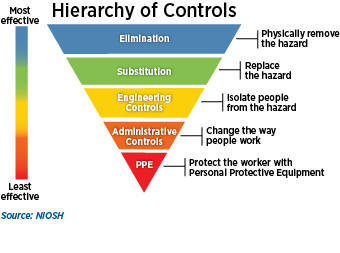
Employers should select the controls that are the most feasible, effective, and permanent.
How to accomplish it
- Eliminate or control all serious hazards (hazards that are causing or are likely to cause death or serious physical harm) immediately.
- Use interim controls while you develop and implement longer-term solutions.
- Select controls according to a hierarchy that emphasizes engineering solutions (including elimination or substitution) first, followed by safe work practices, administrative controls, and finally personal protective equipment.
- Avoid selecting controls that may directly or indirectly introduce new hazards. Examples include exhausting contaminated air into occupied work spaces or using hearing protection that makes it difficult to hear backup alarms.
- Review and discuss control options with workers to ensure that controls are feasible and effective.
- Use a combination of control options when no single method fully protects workers.
Note: Whenever possible, select equipment, machinery, and materials that are inherently safer based on the application of “Prevention through Design” (PtD) principles. Apply PtD when making your own facility, equipment, or product design decisions. For more information, see the link to the NIOSH PtD initiative in Additional Resources.
Action item 3: Develop and update a hazard control plan
A hazard control plan describes how the selected controls will be implemented. An effective plan will address serious hazards first. Interim controls may be necessary, but the overall goal is to ensure effective long-term control of hazards. It is important to track progress toward completing the control plan and periodically (at least annually and when conditions, processes or equipment change) verify that controls remain effective.
How to accomplish it
- List the hazards needing controls in order of priority.
- Assign responsibility for installing or implementing the controls to a specific person or persons with the power or ability to implement the controls.
- Establish a target completion date.
- Plan how you will track progress toward completion.
- Plan how you will verify the effectiveness of controls after they are installed or implemented.
Action item 4: Select controls to protect workers during nonroutine operations and emergencies
The hazard control plan should include provisions to protect workers during nonroutine operations and foreseeable emergencies. Depending on your workplace, these could include fires and explosions; chemical releases; hazardous material spills; unplanned equipment shutdowns; infrequent maintenance activities; natural and weather disasters; workplace violence; terrorist or criminal attacks; disease outbreaks (e.g., pandemic influenza); or medical emergencies. Nonroutine tasks, or tasks workers don’t normally do, should be approached with particular caution. Prior to initiating such work, review job hazard analyses and job safety analyses with any workers involved and notify others about the nature of the work, work schedule, and any necessary precautions.
How to accomplish it
- Develop procedures to control hazards that may arise during nonroutine operations (e.g., removing machine guarding during maintenance and repair).
- Develop or modify plans to control hazards that may arise in emergency situations.
- Procure any equipment needed to control emergency-related hazards.
- Assign responsibilities for implementing the emergency plan.
- Conduct emergency drills to ensure that procedures and equipment provide adequate protection during emergency situations.
Note: Depending on your location, type of business, and materials stored or used on site, authorities including local fire and emergency response departments, state agencies, the U.S. Environmental Protection Agency, the Department of Homeland Security, and OSHA may have additional requirements for emergency plans. Ensure that your procedures comply with these requirements.
Action item 5: Implement selected controls in the workplace
Once hazard prevention and control measures have been identified, they should be implemented according to the hazard control plan.
How to accomplish it
- Implement hazard control measures according to the priorities established in the hazard control plan.
- When resources are limited, implement measures on a “worst-first” basis, according to the hazard ranking priorities (risk) established during hazard identification and assessment. (Note, however, that regardless of limited resources, employers have an obligation to protect workers from recognized, serious hazards.)
- Promptly implement any measures that are easy and inexpensive—e.g., general housekeeping, removal of obvious tripping hazards such as electrical cords, basic lighting—regardless of the level of hazard they involve.
Action item 6: Follow up to confirm that controls are effective
To ensure that control measures are and remain effective, employers should track progress in implementing controls, inspect and evaluate controls once they are installed, and follow routine preventive maintenance practices.
How to accomplish it
- Track progress and verify implementation by asking the following questions:
- Have all control measures been implemented according to the hazard control plan?
- Have engineering controls been properly installed and tested?
- Have workers been appropriately trained so that they understand the controls, including how to operate engineering controls, safe work practices, and PPE use requirements?
- Are controls being used correctly and consistently?
- Conduct regular inspections (and industrial hygiene monitoring, if indicated) to confirm that engineering controls are operating as designed.
- Evaluate control measures to determine if they are effective or need to be modified. Involve workers in the evaluation of the controls. If controls are not effective, identify, select, and implement further control measures that will provide adequate protection.
- Confirm that work practices, administrative controls, and personal protective equipment use policies are being followed.
- Conduct routine preventive maintenance of equipment, facilities, and controls to help prevent incidents due to equipment failure.
#hz-prvnt
Education and training are important tools for informing workers and managers about workplace hazards and controls so they can work more safely and be more productive. Another role of education and training, however, is to provide workers and managers with a greater understanding of the safety and health program itself, so that they can contribute to its development and implementation.
Education and training provides employers, managers, supervisors, and workers with:
- Knowledge and skills needed to do their work safely and avoid creating hazards that could place themselves or others at risk.
- Awareness and understanding of workplace hazards and how to identify, report, and control them.
- Specialized training, when their work involves unique hazards.
Additional training may be needed depending on the roles assigned to employers or individual managers, supervisors, and workers. For example, employers, managers, and supervisors may need specific training to ensure that they can fulfill their roles in providing leadership, direction, and resources for the safety and health program. Workers assigned specific roles in the program (e.g., incident investigation team members) may need training to ensure their full participation in those functions.
Effective training and education can be provided outside a formal classroom setting. Peer-to-peer training, on-the-job training, and worksite demonstrations can be effective in conveying safety concepts, ensuring understanding of hazards and their controls, and promoting good work practices.
Action item 1: Provide program awareness training
Managers, supervisors, and workers all need to understand the program’s structure, plans, and procedures. Having this knowledge ensures that everyone can fully participate in developing, implementing, and improving the program.
How to accomplish it
- Provide training to all managers, supervisors, workers, and contractor, subcontractor, and temporary agency workers on:
- Safety and health policies, goals, and procedures
- Functions of the safety and health program
- Whom to contact with questions or concerns about the program (including contact information)
- How to report hazards, injuries, illnesses, and close calls/near misses
- What to do in an emergency
- The employer’s responsibilities under the program
- Workers’ rights under the Occupational Safety and Health Act
- Provide information on the safety and health hazards of the workplace and the controls for those hazards.
- Ensure that training is provided in the language(s) and at a literacy level that all workers can understand.
- Emphasize that the program can only work when everyone is involved and feels comfortable discussing concerns; making suggestions; and reporting injuries, incidents, and hazards.
- Confirm, as part of the training, that all workers have the right to report injuries, incidents, hazards, and concerns and to fully participate in the program without fear of retaliation.
Action item 2: Train employers, managers, and supervisors on their roles in the program
Employers, managers, and supervisors are responsible for workers’ safety, yet sometimes have little training on safety-related concepts and techniques. They may benefit from specific training that allows them to fulfill their leadership roles in the program.
How to accomplish it
- Reinforce employers, managers, and supervisors’ knowledge of their responsibilities under the Occupational Safety and Health Act and the workers’ rights guaranteed by the Act.
- Train employers, managers, and supervisors on procedures for responding to workers’ reports of injuries, illnesses, and incidents, including ways to avoid discouraging reporting.
- Instruct employers, managers, and supervisors on fundamental concepts and techniques for recognizing hazards and methods of controlling them, including the hierarchy of controls (see “Hazard Prevention and Control“).
- Instruct employers, managers, and supervisors on incident investigation techniques, including root cause analysis.
Action item 3: Train workers on their specific roles in the safety and health program
Additional training may be needed to ensure that workers can incorporate any assigned safety and health responsibilities into their daily routines and activities.
How to accomplish it
- Instruct workers on how to report injuries, illnesses, incidents, and concerns. If a computerized reporting system is used, ensure that all employees have the basic computer skills and computer access sufficient to submit an effective report.
- Instruct workers assigned specific roles within the safety and health program on how they should carry out those responsibilities, including:
- Hazard recognition and controls (see action item 4)
- Participation in incident investigations
- Program evaluation and improvement
- Provide opportunities for workers to ask questions and provide feedback during and after the training.
- As the program evolves, institute a more formal process for determining the training needs of workers responsible for developing, implementing, and maintaining the program.
Action item 4: Train workers on hazard identification and controls
Providing workers with an understanding of hazard recognition and control and actively involving them in the process can help to eliminate hazards before an incident occurs.
How to accomplish it
- Train workers on techniques for identifying hazards, such as job hazard analysis (see OSHA Publication 3071).
- Train workers so they understand and can recognize the hazards they may encounter in their own jobs, as well as more general work-related hazards.
- Instruct workers on concepts and techniques for controlling hazards, including the hierarchy of controls and its importance.
- Train workers on the proper use of work practice and administrative controls.
- Train workers on when and how to wear required personal protective equipment.
- Provide additional training, as necessary, when a change in facilities, equipment, processes, materials, or work organization could increase hazards, and whenever a worker is assigned a new task.
#ed-train
Once a safety and health program is established, it should be evaluated initially to verify that it is being implemented as intended. After that, employers should periodically, and at least annually, step back and assess what is working and what is not, and whether the program is on track to achieve its goals. Whenever these assessments identify opportunities to improve the program, employers, managers, and supervisors—in coordination with workers—should make adjustments and monitor how well the program performs as a result. Sharing the results of monitoring and evaluation within the workplace, and celebrating successes, will help drive further improvement.
Program evaluation and improvement includes:
- Establishing, reporting, and tracking goals and targets that indicate whether the program is making progress.
- Evaluating the program initially and periodically thereafter to identify shortcomings and opportunities for improvement.
- Providing ways for workers to participate in program evaluation and improvement.
Action item 1: Monitor performance and progress
The first step in monitoring is to define indicators that will help track performance and progress. Next, employers, managers, supervisors, and workers need to establish and follow procedures to collect, analyze, and review performance data.
Both lagging and leading indicators should be used. Lagging indicators generally track worker exposures and injuries that have already occurred. Leading indicators track how well various aspects of the program have been implemented and reflect steps taken to prevent injuries or illnesses before they occur.
How to accomplish it
- Develop and track lagging indicators of progress toward established safety and health goals, such as:
- Number and severity of injuries and illnesses
- Results of worker exposure monitoring that show that exposures are hazardous
- Workers’ compensation data, including claim counts, rates, and cost
- Develop and track leading indicators, such as:
- Level of worker participation in program activities
- Number of employee safety suggestions
- Number of hazards, near misses and first aid cases reported
- Amount of time taken to respond to reports
- Number and frequency of management walkthroughs
- Number and severity of hazards identified during inspections
- Number of workers who have completed required safety and health training
- Timely completion of corrective actions after a workplace hazard is identified or an incident occurs
- Timely completion of planned preventive maintenance activities
- Worker opinions about program effectiveness obtained from a safety climate or safety opinion survey
- Analyze performance indicators and evaluate progress over time.
- Share results with workers and invite their input on how to further improve performance.
- When opportunities arise, share your experience and compare your results to similar facilities within your organization, with other employers you know, or through business or trade associations.
Note: Indicators can be either quantitative or qualitative. Whenever possible, select indicators that are measurable (quantitative) and that will help you determine whether you have achieved your program goals. The number of reported hazards and near misses would be a quantitative indicator. A single worker expressing a favorable opinion about program participation would be a qualitative indicator.
Action item 2: Verify that the program is implemented and is operating
Initially and at least annually, employers need to evaluate the program to ensure that it is operating as intended, is effective in controlling identified hazards, and is making progress toward established safety and health goals and objectives. The scope and frequency of program evaluations will vary depending on changes in HIOSH standards; the scope, complexity, and maturity of the program; and the types of hazards it must control.
How to accomplish it
- Verify that the core elements of the program have been fully implemented.
- Involve workers in all aspects of program evaluation, including: reviewing information (such as incident reports and exposure monitoring results); establishing and tracking performance indicators; and identifying opportunities to improve the program.
- Verify that the following key processes are in place and operating as intended:
- Reporting injuries, illnesses, incidents, hazards, and concerns
- Conducting workplace inspections and incident investigations
- Tracking progress in controlling identified hazards and ensuring that hazard control measures remain effective
- Collecting and reporting any data needed to monitor progress and performance
- Review the results of any compliance audits to confirm that any program shortcomings are being identified. Verify that actions are being taken that will prevent recurrence.
Action item 3: Correct program shortcomings and identify opportunities to improve
Whenever a problem is identified in any part of the safety and health program, employers—in coordination with supervisors, managers, and workers—should take prompt action to correct the problem and prevent its recurrence.
How to accomplish it
If you discover program shortcomings, take actions needed to correct them.
- Proactively seek input from managers, workers, supervisors, and other stakeholders on how you can improve the program.
- Determine whether changes in equipment, facilities, materials, key personnel, or work practices trigger any need for changes in the program.
- Determine whether your performance indicators and goals are still relevant and, if not, how you could change them to more effectively drive improvements in workplace safety and health.
Note: The scope and frequency of program evaluations will depend on the scope, complexity, and maturity of the program and on the types of hazards it must control. Program evaluations should be conducted periodically (and at least annually) but might also be triggered by a change in process or equipment, or an incident such as a serious injury, significant property damage, or an increase in safety-related complaints.
#program-eval
In today’s economy, an increasing number of workers are assigned by staffing agencies to work at specific host worksites under the direction and control of the host employer5. Examples include seasonal workers, such as delivery drivers and warehouse workers, who may be placed in both short- and long-term assignments. In these situations, it is important for the staffing agency and the host employer to communicate and coordinate to provide and maintain a safe work environment for their workers.
In other situations, some workers are employed by a host employer and others by a contractor or subcontractor. Examples include electrical or mechanical contractors working in a facility, a vendor installing or maintaining equipment, or long-term contractors providing building cleaning and maintenance. HIOSH refers to these as “multiemployer” worksites. In these circumstances, it is important that each employer and contractor consider how its work and safety activities can affect the safety of other employers and workers at the site.
In both temporary worker and multiemployer situations, safety is enhanced if employers establish mechanisms to coordinate their efforts and communicate effectively to afford all workers equal protection against hazards. These mechanisms include measures to ensure that all workers on site (and their representatives) can participate in preventing injuries and illnesses. Failure to take these steps may undermine safety programs. For example, if the different employers have inconsistent policies for when and where to wear personal protective equipment, workers may mistakenly believe that the equipment is not needed, leading to injury. Inconsistent safety policies may also cause workers to question the credibility of safety and health programs, resulting in less meaningful employee engagement and participation.
Effective communication and coordination among such employers means that, before coming on site, contractors and staffing agencies and their workers are aware of:
- The types of hazards that may be present.
- The procedures or measures they need to use to avoid or control their exposure to these hazards.
- How to contact the host employer to report an injury, illness, or incident or if they have a safety concern.
It also means that host employers and their workers are aware of:
- The types of hazards that may arise from the work being done on site by workers employed by contractors or staffing agencies.
- The procedures or measures needed to avoid or control exposure to these hazards.
- How to contact the contract or staffing firm if they have a safety concern.
- What to do in case of an emergency.
Action item 1: Establish effective communication
Each host employer establishes and implements a procedure to ensure the exchange of information about hazards present on site and the hazard control measures in place. Thus, all workers on the site are aware of worksite hazards, and the methods and procedures needed to control exposures to them.
How to accomplish it
- The host employer communicates with contractors and staffing agencies to determine which among them will implement and maintain the various parts of the safety and health program, to ensure protection of all on-site workers before work begins. These determinations can be included in contract documents that define the relationships between the parties.
- The host employer establishes and implements procedures to exchange information with contractors and staffing agencies about hazards present in the workplace and the measures that have been implemented to prevent or control such hazards.
- The host employer gathers and disseminates information sufficient to enable each employer to assess hazards encountered by its workers and to avoid creating hazards that affect workers on the site.
- Contractors and staffing agencies regularly give the host employer any information about injuries, illnesses, hazards, or concerns reported by their workers and the results of any tracking or trend analysis they perform.
- Each contractor establishes and implements a procedure for providing the host employer with information about the hazards and control measures associated with the work being done by its workers and the procedures it will use to protect workers on the site.
- The host employer gives contract employers and staffing agencies the right to conduct site visits and inspections and to access injury and illness records and other safety and health information.
- The host employer communicates with contractors and staffing agencies and their workers about nonroutine and emergency hazards and emergency procedures.
- Information is communicated before on-site work starts and, as needed, if conditions change.
Action item 2: Establish effective coordination
Host employers, contractors, and staffing agencies coordinate on work planning, scheduling, and resolving program differences to identify and work out any concerns or conflicts that could impact safety or health.
How to accomplish it
Host employers:
- Include in contracts and bid documents any safety-related specifications and qualifications and ensure that contractors and staffing agencies selected for the work meet those requirements.
- Identify issues that may arise during on-site work and include procedures to be used by the host employer and contractors and/or staffing agencies for resolving any conflicts before work starts.
Host employers coordinate with contractors and staffing agencies to:
- Ensure that work is planned and scheduled to minimize impacts on safety.
- Ensure that staffing agency workers are adequately trained and equipped before arriving on the worksite.
- Harmonize their safety and health policies and procedures to resolve important differences, so that all workers at the site have the same protection and receive consistent safety information.
Host employers and staffing agencies:
- Work together to deal with unexpected staffing needs by ensuring that enough trained and equipped workers are available or that adequate lead time is provided to train and equip workers.
- Make sure that managers with decision-making authority are available and prepared to deal with day-to-day coordination issues.
#other-employees
- Contractor: An individual or firm that agrees to furnish materials or perform services at a specified price, and controls the details of how the work will be performed and completed. ↩︎
- Staffing agency: A firm that provides temporary workers to host employers. A staffing agency hires its own employees and assigns them to support or supplement a client’s workforce in situations involving employee absences, temporary skill shortages, seasonal workloads, and special projects. ↩︎
- Temporary workers: Workers hired and paid by a staffing agency and assigned to work for a host employer, whether or not the job is actually temporary. ↩︎
- Under HIOSH’s injury and recordkeeping rule (incorporates OSHA’s 29 CFR 1904 under §12-52.1-2 HAR) employers are required to establish a “reasonable” procedure for employees to report work-related injuries and illnesses promptly and accurately. A reasonable procedure is defined as one that would not deter or discourage a reasonable employee from accurately reporting a workplace injury or illness. ↩︎
- Host employer: An employer who has general supervisory authority over the worksite, including controlling the means and manner of work performed and having the power to correct safety and health hazards or require others to correct them. ↩︎